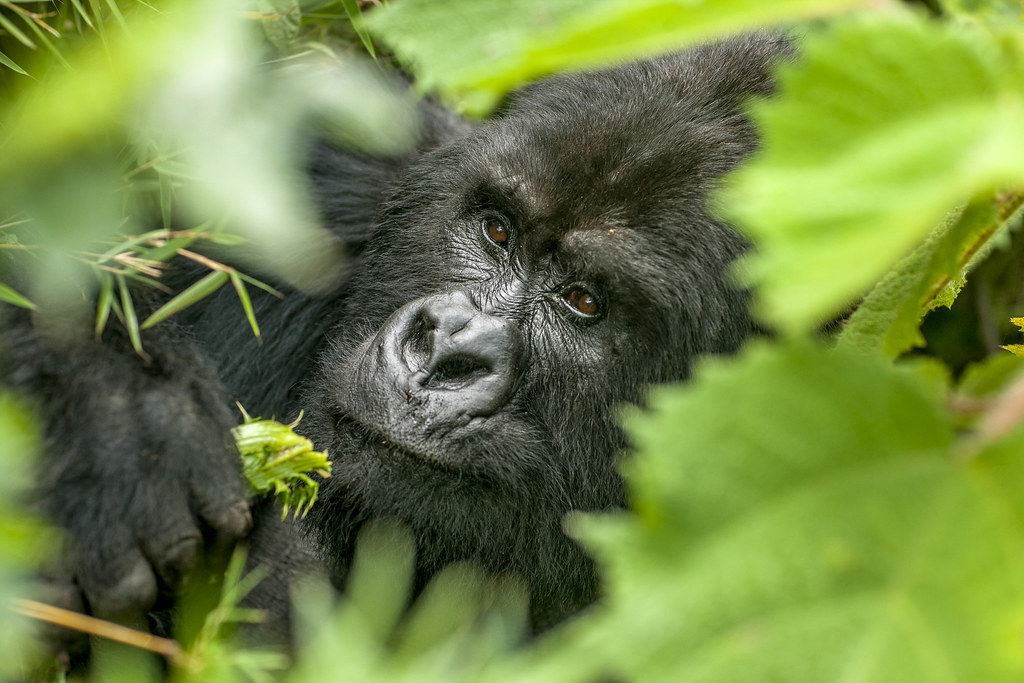
The Hirwa gorilla family is a smaller mountain gorilla group in Rwanda’s Volcanoes National Park whose name means “the lucky one,” formed in 2006 from members of the Sabyinyo and Group 13 families and known for raising a set of twins. It ranges around the slopes of Mount Sabyinyo and Mount Gahinga and is trekked on a $1,500 permit in 2026. Volcanoes National Park lies in northern Rwanda near Musanze along the Virunga Mountains, holding part of the world’s only wild mountain gorilla population.
This guide covers how the Hirwa family came together, the twins behind its name, its crossing into Uganda and difficult return, where it ranges, and what the trek involves in 2026. Member figures are recent estimates, since the group’s size has changed sharply through both births and losses.
How the Hirwa Gorilla Family Was Formed
The Hirwa family is one of the younger groups in the park, habituated in 2006. It did not split from a single parent group in the usual way. Instead it came together from gorillas that broke away from the Sabyinyo and Group 13 families, with more individuals joining of their own accord over time.

That voluntary gathering is the source of the name. Hirwa means “the lucky one” in Kinyarwanda, given for the good fortune of a new group forming and growing from members drawn in from elsewhere. For a family built this way to hold together and produce young was seen as luck in itself.
The Twins That Gave the Hirwa Family Its Name
The family’s reputation for luck was sealed when it produced a set of twins in 2011. Twins are rare among mountain gorillas, and only a small number of families across the whole Virunga region, spanning Rwanda, Uganda, and the Democratic Republic of Congo, have had them. The birth made Hirwa one of the better known groups despite its small size.
Twins draw attention because they are unusual and because raising two infants at once is demanding for a mother. For visitors, a family with twins offers a chance to see something most treks do not, though as with any sighting it depends on where the young are and what the group is doing during your hour.
The Hirwa Family’s Crossing into Uganda and Return
In August 2019 the Hirwa family crossed the border into Mgahinga Gorilla National Park on the Uganda side of the Virunga massif, a reminder that these gorillas move across national boundaries that mean nothing to them. The crossing turned into a hard period for the group.
During its time in Uganda the family lost seven members. Four are believed to have died from a lightning strike, and the dominant silverback was among the dead. The group returned to Volcanoes National Park in April 2020 under a new silverback named Uburanga. The episode reshaped the family and is part of why its recent size has swung more than most.
Where the Hirwa Gorilla Family Ranges
The Hirwa family ranges around the foothills of Mount Sabyinyo, often toward the side of Mount Gahinga. This is broadly the same zone shared by several of the families that contributed to its formation, in the part of the park where Rwanda’s border meets Uganda.
One trait visitors note is that the family tends to stay close together, so on a good day it is possible to see most of its members in one place. The trade-off is that a small group on the move can be harder to pin down on a given morning than a large, slow-feeding one.
Group Size and Members of the Hirwa Family
Recent counts place the Hirwa family at roughly 13 to 18 members under the silverback Uburanga, recovering from the losses of the 2019 to 2020 period. The group includes adult females, juveniles, and infants alongside the dominant male. Its size has moved more than most families in recent years, first growing after formation, then dropping with the deaths in Uganda, and rebuilding since.
The compact size gives the family a close feel during a visit. With members staying near one another, the hour can offer a clear view of how the group interacts, from the silverback’s watchfulness to the young testing their independence nearby.
What the Hirwa Gorilla Trek Is Like
The Hirwa trek is generally rated easier to moderate, since the family ranges in the lower Sabyinyo and Gahinga zone rather than high on the steep volcanoes. The main variable is locating a small group that can be hard to find on certain days, which sometimes lengthens the search even when the terrain is not severe.
Standard preparation covers it: boots with grip and ankle support, rain layers, and a basic level of fitness. A porter at the trailhead helps with your pack and supports local income. Because finding the group can take time, an early start and patience matter more here than raw climbing ability.
Best Time to Trek the Hirwa Gorilla Family
The Hirwa family is trekked year-round. Because it ranges lower than the high-altitude groups, it is less punished by wet-season mud, though the search for a small group is easier on the firmer trails of the drier months. The dry stretches run June to September and December to February.
The wetter months of March to May and November bring the low-season discount and thinner crowds. Denser vegetation in the rains can make a small group harder to spot, so off-peak visitors should plan for a longer morning in exchange for the lower price.
Permit Cost to Trek the Hirwa Gorilla Family
The Hirwa family is reached on the standard gorilla permit, priced at $1,500 per person in 2026 for international visitors, the same fee as every family in the park. It covers entry, guides, trackers, and the one-hour visit, and excludes lodging, transport, and tips.
$1,500 per person for one trek, set by the Rwanda Development Board and identical for all families.
$1,050 per person from November to May, with a qualifying two-night stay in Akagera or Nyungwe National Park.
About $500 for foreign residents and rest-of-Africa visitors, and roughly $200 for East African citizens, on proof of status.
Around $15 to $20 for a porter at the trailhead, plus tips for guides and trackers, paid on the day.
The fixed price means the Hirwa family costs the same as any other. What sets the trek apart is the chance of twins and a small group, balanced against a search that can run long.
How to Book and Reach the Hirwa Family
Permits come from the Rwanda Development Board, bought directly online or through a licensed operator. You book a trekking day rather than a specific family, and Hirwa is assigned at the Kinigi briefing. Raise any preference in advance and again on the morning, and be clear about whether a longer search is acceptable.
The park is about a two to three hour drive from Kigali to Musanze and the Kinigi headquarters. The briefing begins around 7 in the morning, so most visitors stay near the park the night before rather than driving up at dawn, which matters all the more for a family that may take time to find.
What does the name Hirwa mean?
Hirwa means “the lucky one” in Kinyarwanda. The name reflects the group’s good fortune in forming and growing from members who joined voluntarily, and later in producing a rare set of twins.
Does the Hirwa family really have twins?
Yes. The family produced a set of twins in 2011, which is uncommon among mountain gorillas. Only a small number of families across the Virunga region have had twins, which is part of why Hirwa is well known despite its small size.
Why did the Hirwa family go to Uganda?
Mountain gorillas move freely across borders, and in 2019 the family crossed into Mgahinga Gorilla National Park in Uganda. It returned to Volcanoes National Park in 2020 after losing seven members, including four to a suspected lightning strike, with a new silverback named Uburanga leading.
How hard is the Hirwa trek?
It is generally rated easier to moderate because the family ranges in the lower Sabyinyo and Gahinga zone. The main challenge is that a small group can be hard to locate on some days, which can lengthen the search even when the terrain is gentle.
How much does the Hirwa trek cost?
The permit is $1,500 per person in 2026, the same as for every family in the park. A low-season rate of $1,050 applies from November to May with a qualifying stay in Akagera or Nyungwe, and reduced rates exist for residents and East African citizens.
Explore our gorilla trekking in Rwanda for a private, tailor-made trip.