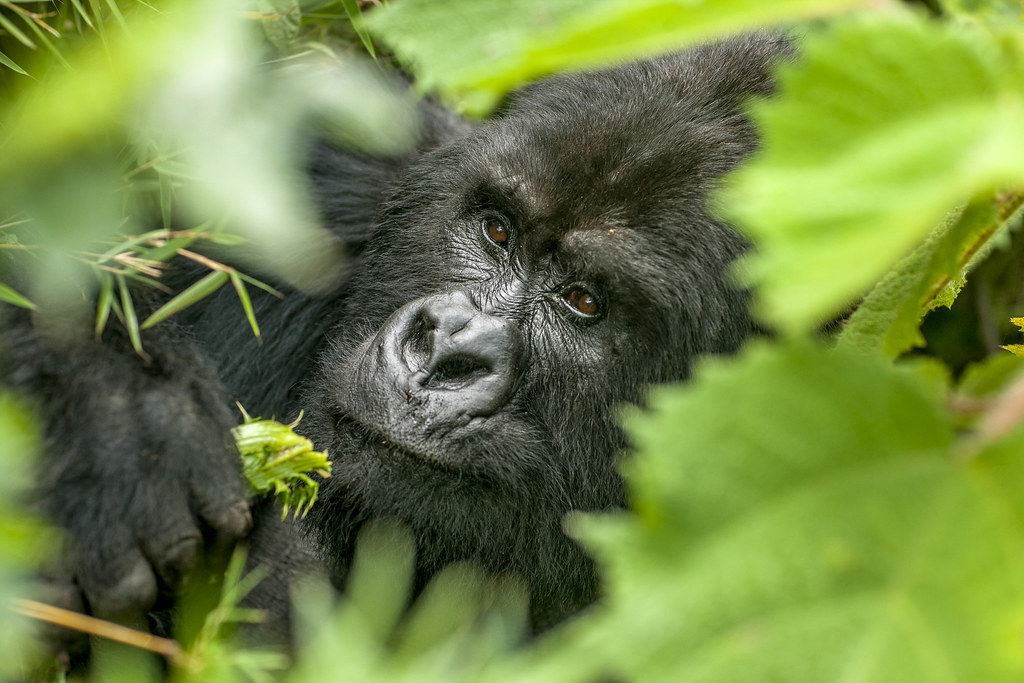
The Susa gorilla family, often written as Susa A, is the most historically significant mountain gorilla group in Rwanda’s Volcanoes National Park, studied by Dian Fossey and named after the Susa River that runs through its range on Mount Karisimbi. It was once the largest family in the park before splitting into several groups, and the trek to reach it is among the hardest. Visitors trek it on a $1,500 permit in 2026. Volcanoes National Park lies in northern Rwanda near Musanze along the Virunga Mountains.
This guide covers the family’s long research history, the twins that made it famous, the splits that reshaped it, where it ranges, and what the demanding trek involves in 2026. The member figures are recent estimates, since the group’s size has changed dramatically through births, deaths, and repeated splits.
The Research History of the Susa Gorilla Family
The Susa family takes its name from the Susa River, the stream that runs through the country it calls home on the lower slopes of Mount Karisimbi. The family was formed in the 1970s and became one of the groups studied by Dian Fossey during her years of research in the Virunga Mountains.

That long association with research is the source of the family’s standing. It is the group most often requested by name and the one most tied to the history of how mountain gorillas came to be understood and protected. For visitors who know that story, reaching Susa carries a weight that the newer families do not.
The Famous Twins of the Susa Family
The Susa family gained wider fame when it produced a set of twins, Impano and Byishimo. Twins are rare among mountain gorillas, and a famous pair in the best known family added to the group’s profile. The birth drew attention from researchers and visitors alike.
Twins are demanding for a mother to raise, and their survival is never assured on the cold, high slopes. Their presence in the Susa story is part of why the family became so widely recognised, beyond its research history and its former size.
How the Susa Family Split into Several Groups
For years the Susa family was the largest group in the park, with counts reported as high as the low 40s. Around 2008 and 2009 it began a series of splits. A faction broke away to form the Karisimbi family, also called Susa B, and further splits over the following years produced the Igisha and Isimbi groups.
The result is that several of the families a visitor can trek today trace their origin to the original Susa group. The core Susa family, Susa A, now holds a fraction of its former size, having shed members to each new group as it formed.
Where the Susa Gorilla Family Ranges
The Susa family ranges on the lower base of Mount Karisimbi, the tallest of the Virunga volcanoes at 4,507 metres. The country runs from bamboo at lower levels into the mixed high-altitude vegetation above, and the family is used to moving between these zones with the seasons and the bamboo shoots.
The high ground is the single biggest factor in the trek. Unlike the families near the park boundary, Susa sits where reaching it means a long climb at altitude, and the group’s movements up and down Karisimbi make the day’s length hard to predict.
Group Size and Members of the Susa Family
The core Susa family now holds around 19 members in recent counts, including the dominant silverback, additional silverbacks, adult females, and young. This is far smaller than its peak before the splits, but it remains a substantial group, and its members carry the line that researchers have followed for decades.
For visitors who reach it, the family offers strong social activity and the sense of meeting the most documented group in the park. The effort of the climb is rewarded with a family whose history is woven through the whole story of mountain gorilla research.
What the Susa Gorilla Trek Is Like
The Susa trek is usually the hardest in the park. The family ranges high on Karisimbi, the climb is long and steep, and the search can take several hours each way before the descent. Guides tend to assign this family to younger, fitter visitors, and accounts describe the trek as the most demanding option, balanced by being among the most rewarding.
Serious preparation pays off here. Sturdy boots with strong grip, rain gear, layers for the altitude, and a good level of fitness are all worth having, and a porter for your pack makes a real difference on the climb. A walking pole helps on the long descent, which on wet ground can be as tiring as the ascent.
Best Time to Trek the Susa Gorilla Family
The season matters more for Susa than for almost any other family, because the long Karisimbi climb is far harder on wet, slick ground. The drier months of June to September and December to February give the firmest footing and the safest conditions for a demanding ascent, and they are the busiest for permits.
The wetter months of March to May and November bring heavy mud on the high slopes and the low-season discount. For a trek this strenuous, the rains add real difficulty, so only fit, well-prepared visitors should plan a Susa climb off-peak in exchange for the lower price.
Permit Cost to Trek the Susa Gorilla Family
The Susa family is reached on the standard gorilla permit, priced at $1,500 per person in 2026 for international visitors, the same fee as every family in the park. It covers entry, guides, trackers, and the one-hour visit, and excludes lodging, transport, and tips.
$1,500 per person for one trek, set by the Rwanda Development Board and identical for all families.
$1,050 per person from November to May, with a qualifying two-night stay in Akagera or Nyungwe National Park.
About $500 for foreign residents and rest-of-Africa visitors, and roughly $200 for East African citizens, on proof of status.
Around $15 to $20 at the trailhead, well worth it on the long Karisimbi climb, plus tips for guides and trackers.
The fixed price means the hardest trek in the park costs the same as the easiest. With Susa, the higher cost is paid in effort and time rather than money.
How to Book and Reach the Susa Family
Permits are sold by the Rwanda Development Board, online or through a licensed operator. You book a trekking day rather than a named family, and Susa is assigned at the Kinigi briefing, generally to fit visitors who have asked for a challenge. Make your fitness and your preference clear in advance and on the morning, and be honest about your limits, since this is a genuinely hard day.
The park is about a two to three hour drive from Kigali to Musanze and the Kinigi headquarters. Because a Susa trek can fill the whole day and the briefing starts around 7 in the morning, staying near the park the night before is the only practical option rather than driving up at dawn.
Why is the Susa family so famous?
The Susa family was studied by Dian Fossey and is the group most tied to the history of mountain gorilla research. It was once the largest family in the park and produced a famous set of twins, which together made it the best known group in Volcanoes National Park.
Is the Susa trek the hardest in Rwanda?
It is usually the hardest. The family ranges high on Mount Karisimbi, so the climb is long and steep and can take several hours each way. Guides tend to assign it to younger, fitter visitors who have asked for a challenge.
What are the names of the Susa twins?
The famous twins are Impano and Byishimo. Twins are rare among mountain gorillas, and a famous pair in the best known family added to the group’s profile.
Why did the Susa family split?
The family grew very large and, from around 2008, divided repeatedly. The splits produced the Karisimbi group, also called Susa B, followed by Isimbi and Igisha, so several families a visitor can trek today trace back to the original Susa group.
How much does the Susa trek cost?
The permit is $1,500 per person in 2026, the same as for every family in the park. A low-season rate of $1,050 applies from November to May with a qualifying stay in Akagera or Nyungwe, and reduced rates exist for residents and East African citizens.
Browse our gorilla safari to begin planning your journey.