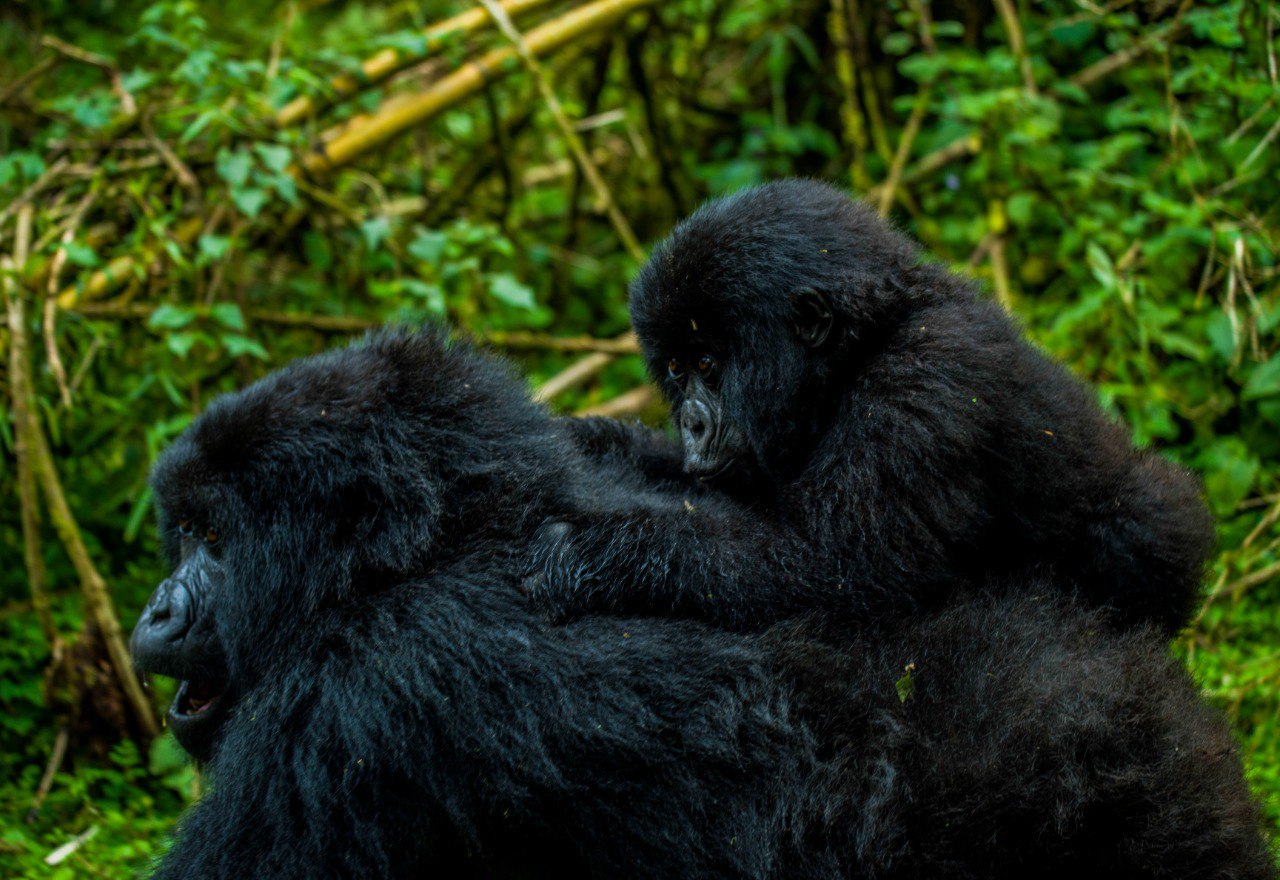
Combining gorilla trekking and an Akagera safari pairs the mountain gorillas of Volcanoes National Park in Rwanda’s northwest with the savannah wildlife of Akagera National Park in the east, including lions, elephants, rhinos, and buffalo. The two parks sit at opposite ends of a small country, so a week ties them together, and a low-season visit to both can unlock the $1,050 gorilla permit instead of the usual $1,500. Volcanoes National Park lies in northern Rwanda near Musanze along the Virunga Mountains.
This guide explains why the pairing works, what Akagera adds, a sample route, and how to plan it. Together the two parks give the forest primates and the classic Big Five safari in a single, compact trip.
Of all the ways to extend a gorilla trip, adding Akagera is the one that changes the character of the holiday most completely, turning a focused primate visit into a rounded safari that spans both forest and savannah. Because the two parks sit at opposite corners of a compact country, the pairing is far easier than the distance on a map suggests, and a single well-planned week ties them together comfortably. The result is a trip that few destinations can match for variety, delivering two entirely different wildlife worlds within one set of borders.
Why Pair the Gorillas with Akagera
Volcanoes National Park delivers the forest primate experience, but it cannot offer big-game viewing. Akagera fills that gap, a savannah and wetland park with the Big Five, giving a trip both the intimacy of an hour with gorillas and the sweep of a classic African safari.
The contrast is the appeal. One day you are climbing through misty montane forest to sit with a gorilla family, and another you are watching elephants at a waterhole or scanning for lions across grassland. Few countries let you combine such different ecosystems so easily, and Rwanda’s small size makes it practical.
What Akagera National Park Offers
Akagera, in eastern Rwanda near the Tanzanian border, is the country’s only savannah park, restored over the past decade into a thriving Big Five destination. Lions and rhinos have been reintroduced, joining elephants, buffalo, giraffes, zebras, and abundant plains game across rolling grassland and lakes.
Game drives are the main activity, with a boat safari on its lakes offering hippos, crocodiles, and rich birdlife. The park’s recovery is itself a conservation success story, so a visit pairs naturally with the gorilla conservation narrative of the volcanoes.
How the Two Parks Fit Together
The parks sit at opposite ends of Rwanda, Akagera in the east and Volcanoes in the northwest, but the country is small enough that a cross-country transfer is a manageable part of a week-long trip. Most itineraries place Akagera first or last, with the gorillas as the centrepiece.
The drive between them passes through Kigali, so a city tour or the Genocide Memorial often slots into the route. Planning the order around your international flights and the gorilla trekking date, which is fixed by your permit, makes the logistics straightforward.
The Low-Season Permit Bonus
A major practical reason to add Akagera is the low-season permit. From November to May, genuinely combining the gorilla trek with visits to both Akagera and Nyungwe national parks qualifies you for the $1,050 permit, a $450 saving over the standard $1,500.
The condition is real: a token stop does not count, and you must travel in the wetter months. But for a week-long trip that includes a proper two-night Akagera stay, the discount effectively helps pay for the extra park, turning a fuller itinerary into better value rather than simply more spending.
When to Go
The dry seasons, June to September and December to February, are easiest for both parks, with better game viewing in Akagera as animals gather at water and firmer trails for the gorilla trek. Gorillas are seen year-round, so timing is more about comfort and the savannah wildlife.
The wetter months, when the low-season permit applies, bring green scenery and fewer crowds, with rain possible any day. For travellers prioritising the permit discount, the November to May window is the trade, balancing some rain against a cheaper permit and a quieter trip.
What Each Park Adds to the Other
The two parks are more than a checklist; each frames the other. After the close, quiet intensity of an hour with a gorilla family, the open space and big herds of Akagera feel expansive and free, while after the savannah, the misty, enclosed forest of the volcanoes feels intimate and rare. The contrast sharpens the appreciation of both.
They also tell a shared conservation story from two angles. The gorillas show conservation through a tiny, intensively protected population, while Akagera shows it through the restoration of an entire ecosystem, with species reintroduced and poaching brought under control. Seen together, they give a fuller picture of how Rwanda has rebuilt its wild places.
Permit and Cost of the Combination
The trip’s core cost is the gorilla permit, $1,500 or $1,050 in the low season, plus Akagera’s park and activity fees, lodging at both parks, and cross-country transport.
$1,500 per person in 2026, or $1,050 in the low season when genuinely combining Akagera and Nyungwe.
Park entry plus game drives and an optional boat safari, far below the gorilla permit.
At both parks across a week, the main variable in the total.
Cross-country transfers via Kigali, often bundled into a tour.
For travellers who want both forest primates and a Big Five safari, the gorilla-and-Akagera week is the natural choice, and the low-season permit can make it more affordable than it first appears. It is Rwanda in miniature, from misty volcanoes to open savannah.
Practically, the order of the two parks usually comes down to flights and the fixed trekking date. Many travellers prefer to end on the gorillas as the emotional high point, doing Akagera first and building toward the forest; others do the reverse to recover gently in the savannah after the demanding climb. Either works, and your operator can shape the route around the permit date once it is secured, since that single fixed point is what everything else must accommodate.
Whichever order you choose, secure the gorilla permit before fixing anything else, because that single date is the fixed point the whole cross-country route has to be built around.
Can you combine gorilla trekking with an Akagera safari?
Yes. The two parks sit at opposite ends of Rwanda, the gorillas in the northwest and Akagera’s savannah in the east, and a week-long trip ties them together. It pairs an hour with a gorilla family with a classic Big Five safari.
What animals are in Akagera National Park?
Akagera is Rwanda’s Big Five savannah park, with lions and rhinos reintroduced over the past decade, joining elephants, buffalo, giraffes, zebras, and plains game. A boat safari on its lakes offers hippos, crocodiles, and rich birdlife.
How long do I need for a gorillas and Akagera trip?
About a week. A typical route spends two nights in Akagera for game drives and a boat safari, then crosses to Volcanoes National Park for the gorilla trek and a second activity, returning via Kigali.
Does adding Akagera reduce the gorilla permit cost?
It can. From November to May, genuinely combining the trek with both Akagera and Nyungwe qualifies you for the $1,050 low-season permit, a $450 saving. A token stop does not count; you need a proper visit to both parks.
When is the best time for this combination?
The dry seasons, June to September and December to February, are easiest, with better Akagera game viewing and firmer gorilla trails. The wetter low-season months bring the permit discount, green scenery, and fewer crowds, with rain possible.