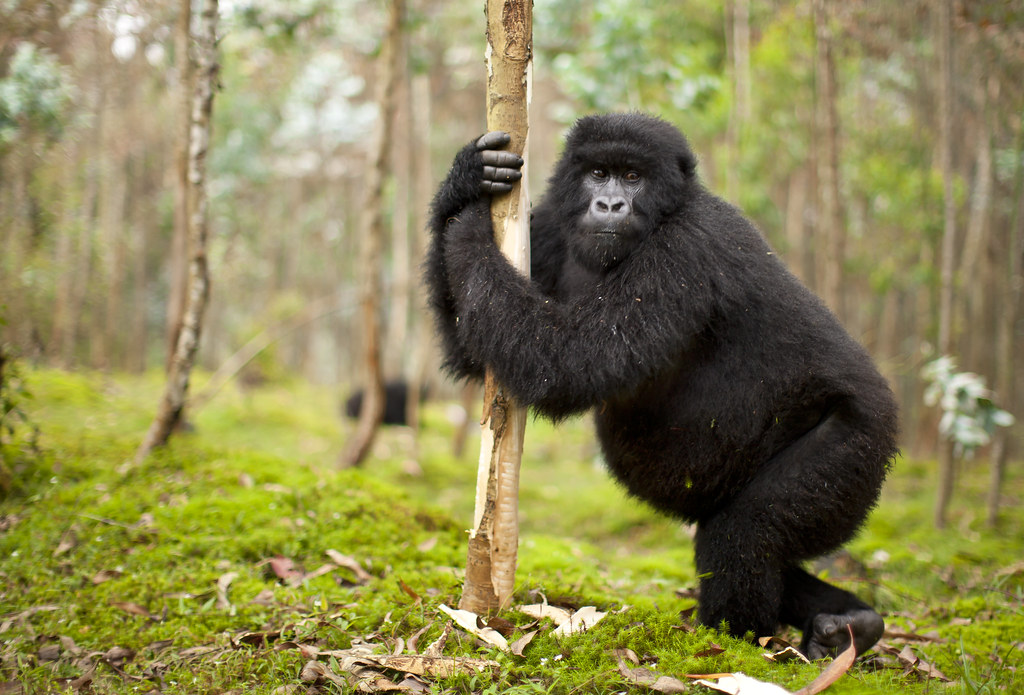
Gorilla tourism protects gorillas by turning them into a source of income that funds ranger patrols, veterinary care, and community programmes, giving local people and the government a strong reason to keep the animals safe. In Rwanda, the $1,500 permit and a revenue-sharing scheme have helped the mountain gorilla population recover from fewer than 300 in the early 1980s to around 1,063 today. Volcanoes National Park lies in northern Rwanda near Musanze along the Virunga Mountains, holding part of the world’s only wild mountain gorilla population.
This guide explains how the money from trekking translates into protection, how communities benefit and why that matters, and how the rules and research that tourism funds keep the gorillas safe. Mountain gorillas are one of the few great ape populations that is growing, and tourism is central to why.
How Permit Money Funds Protection
The most direct way tourism protects gorillas is through money. Each $1,500 permit funds the rangers who patrol the forest, the trackers who monitor each family daily, and the systems that keep poaching in check. A habituated family watched by trackers every day is far harder to harm than an unobserved one.

This daily monitoring also means snares can be found and removed quickly, sick or injured gorillas can be spotted and treated, and any threat is noticed early. The permit price, often questioned as high, is what pays for this constant, protective presence around the animals.
Giving Communities a Reason to Protect
Tourism also works by aligning the interests of local communities with the gorillas’ survival. Rwanda operates a revenue-sharing scheme that returns a share of park income to the communities around Volcanoes National Park, funding schools, clean water, health projects, and small businesses.
The figure is significant. Rwanda’s tourism has contributed hundreds of millions of dollars to the national economy in recent years, with around 10 percent of park revenue returned to surrounding communities, a scheme described as among the most generous in Africa. When people benefit directly from living gorillas, protecting them becomes a shared local interest rather than an outside imposition. Around Musanze, the gateway district, two decades of gorilla tourism have helped transform a quiet farming area into a centre of conservation-driven development, with schools, clinics, and businesses funded in part by visitors who came for the gorillas.
The Population Recovery Tourism Helped Drive
The results show in the numbers. Mountain gorillas fell to around 254 individuals in the Virunga area by 1981, on the brink of extinction. Through decades of protection, anti-poaching work, and tourism funding, the population has climbed to roughly 1,063 today, split between the Virunga massif and the Bwindi-Sarambwe ecosystem.
This recovery led the species to be reclassified from Critically Endangered to Endangered in 2018, a rare piece of good news in great ape conservation. Mountain gorillas are now one of the only great ape populations that is growing rather than shrinking, and regulated tourism is widely credited as a major reason. The Virunga massif, shared by Rwanda, Uganda, and the Democratic Republic of Congo, holds around 604 of these animals, with Volcanoes National Park home to a large share of them.
The progress is fragile, though. With the entire species numbering only around a thousand animals in two small, isolated pockets, a single disease outbreak or a lapse in protection could undo years of gains, which is precisely why the funding and vigilance that tourism sustains remain so important.
Turning Poachers into Protectors
Tourism also changes livelihoods. The porters who carry daypacks, the guides, lodge staff, and craft sellers all earn from visitors, and many come from communities that once relied on the forest in harmful ways. Some porters are former poachers for whom tourism offers a better, legal income.
When a living gorilla is worth far more to a community than a dead one, the incentive to poach collapses. This shift, from seeing the forest as something to exploit to something to protect, is one of the quieter but most powerful ways tourism safeguards the gorillas over the long term. The annual Kwita Izina ceremony, where new infants are named, has become a national celebration since 2005 and has helped turn gorilla conservation into a source of local and national pride rather than a restriction imposed from above.
Funding Veterinary Care and Research
Tourism revenue and the attention it brings also support veterinary care and research. Programmes that provide medical intervention for sick or injured gorillas, and the long-term research that monitors family health and behaviour, depend on the funding and infrastructure that tourism helps sustain.
Daily tracking for tourism doubles as health monitoring, so a gorilla caught in a snare or showing illness is spotted quickly and can be treated. This blend of tourism, research, and veterinary work has reduced deaths from preventable causes and is part of why the population keeps growing. The long research tradition in these mountains, stretching back to Dian Fossey‘s work at Karisoke, also means decades of data on individual gorillas and families, which informs how they are protected and how tourism is managed around them.
The Rules That Tourism Brings
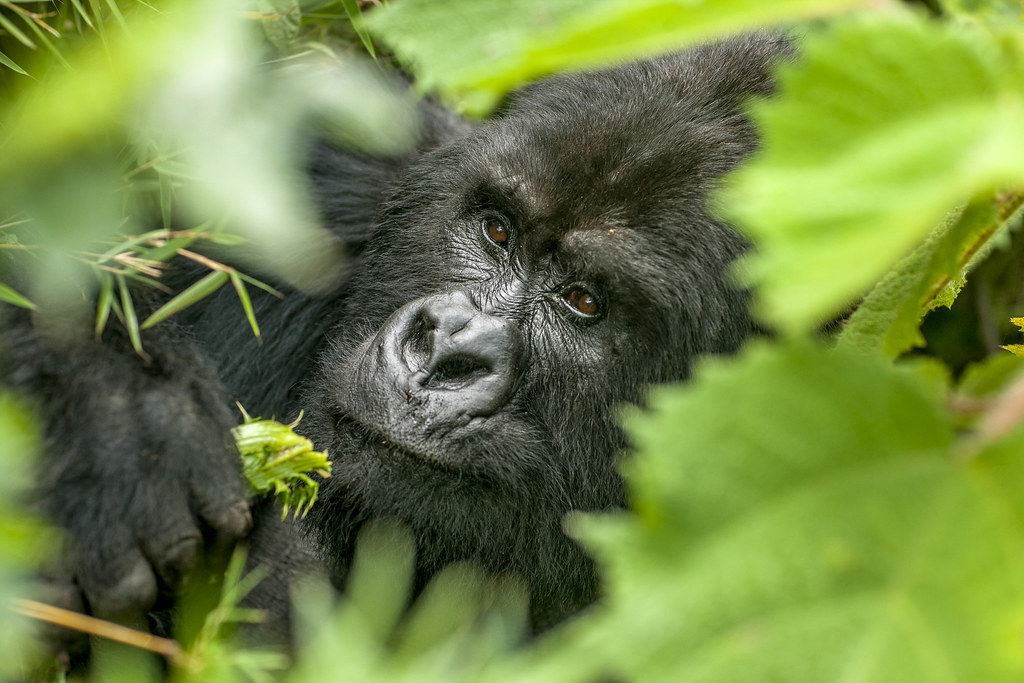
The structure of gorilla tourism is itself protective. The rules that govern every visit, the eight-visitor cap, the one-hour limit, the distance requirement, masks, and the no-sick rule, exist to keep human disease and stress away from the animals while still allowing the income that funds their protection.
Without tourism there would be no permits, no revenue, and far less reason or money to enforce protection. The rules are the framework that lets people visit gorillas without harming them, turning a potential threat into a sustainable source of support. In that sense, every rule a visitor follows is a small repayment into the system that keeps the animals alive, and the structure as a whole is what makes the difference between tourism that protects and tourism that exploits.
The Permit at the Centre of It All
Every strand of this protection runs through the permit. At $1,500 per person in 2026, it funds patrols, communities, research, and veterinary care, and its limited number keeps visitor pressure low. The price reflects conservation as much as access.
$1,500 per person in 2026, funding ranger patrols, monitoring, veterinary care, and community programmes.
Around 10 percent of park revenue is returned to surrounding communities, among the most generous schemes in Africa.
From about 254 in 1981 to roughly 1,063 today, with the species downgraded to Endangered in 2018.
Porters, guides, and lodge staff earn from tourism, replacing income once drawn from harming the forest.
Seen this way, the permit is not just a ticket but a contribution to a system that has pulled mountain gorillas back from the edge. Visiting responsibly is itself an act of conservation.
How does tourism protect gorillas?
Tourism funds ranger patrols, daily monitoring, veterinary care, and community programmes, and gives local people a financial reason to protect the animals. By making living gorillas valuable, it reduces poaching and supports the systems that keep families safe.
How much has the gorilla population recovered?
Mountain gorillas have risen from about 254 individuals in 1981 to roughly 1,063 today. The recovery led to the species being reclassified from Critically Endangered to Endangered in 2018, making it one of the few great ape populations that is growing.
Do local communities benefit from gorilla tourism?
Yes. Rwanda returns around 10 percent of park revenue to surrounding communities through a revenue-sharing scheme, funding schools, water, health projects, and businesses. Many local people also earn directly as porters, guides, and lodge staff.
Does the permit fee really help conservation?
Yes. The $1,500 permit funds patrols, monitoring, veterinary care, and community programmes, and its limited number keeps visitor pressure low. The price reflects the cost of protecting a small, vulnerable population as much as the access it grants.
How does tourism reduce poaching?
By providing better, legal income. Porters, guides, and lodge staff earn from visitors, and some porters are former poachers. When a living gorilla is worth far more to a community than a dead one, the incentive to poach falls away.
Ready to go? Start planning your trip with our gorilla trekking.